HOME > Product > Thermal Materials
| Thermal Material |
|
|
|
Why is Heat Transfer important?
In these days, a lot of electronic devices demand?
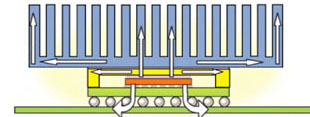
very high levels of thermal management. The objective of all thermal control programs in electronic packaging is the efficient removal of heat from device junctions to the ambient environment.
And packaging of portable electronics is slim, which means that components are more closely packed together, so the amount of heat is increased.
Clock speed of processor and overall power density are increasing, which means that more heat must be dissipated per volume of electronic equipment than ever before.
IDT Series is DooSung’s trademark, thermal management materials combine high thermal conductivity and superior flame-retardancy with specific organic properties of heat resistance and electrical insulation.
Achieving this goal is required a thorough understanding of heat transfer fundamentals as well as knowledge of available interface materials, and how their key physical properties affect the heat transfer process.
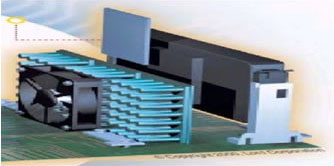
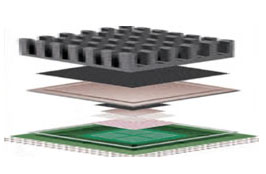
Attaching heat sink to a semiconductor package surface requires that two commercial grade surfaces to be brought into intimate contact.
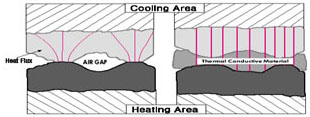
These surfaces are usually characterized by a microscopic surface roughness superimposed macroscopic non-planarity that can give the surfaces a concave, convex or twist shape. When two such surfaces are joined, contact occurs only at the high points. The low points form air-filled voids.
Typical contact area can consist of more than 90percent air voids, which represents a significant resistance to heat flow. IDT Series is used to eliminate these interstitial air gaps from the interfaces.
Because the material has a greater thermal conductivity than through air it replaces,the resistance across the joints decreases, while the component junction temperature will be reduced.
|
| Properties of Thermal Interface Materials |
|
|
Thermal impedance is the measure of the total resistance to the flow of heat from a hot surface through an interface material into a cold surface.It is measured according to the ASTM D5470 test method. Although the current version of this method is specific to high durometer insulating pad materials tested at high clamping forces,the method has been successfully adapted for use with low durometer materials as well as fluid compounds.
|
  |
  |
 |